
Your employer may call you a “1099 contractor.” They may make you sign an independent contractor agreement. They may tell you that you are “self-employed,” that you are “not on payroll,” or that you are “responsible for your own taxes.”
But in California, the label is not the law.
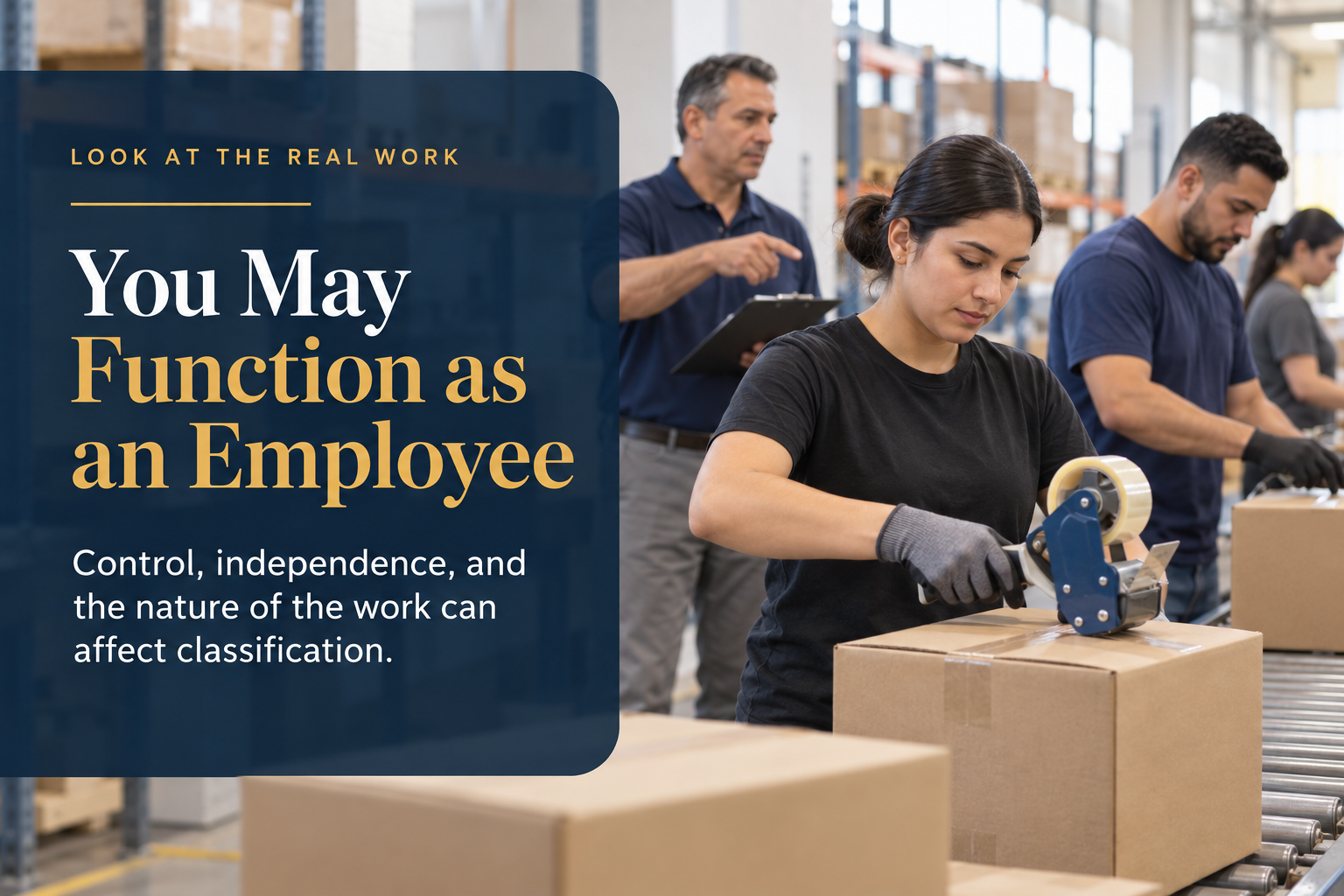
Many workers are classified as independent contractors even though they function like employees. They work set schedules, follow company rules, report to managers, use company systems, wear company uniforms, serve the company’s customers, and perform work that is central to the business. If that sounds familiar, you may have been misclassified—and you may be owed wages, overtime, reimbursements, penalties, and other protections.

In California, many workers are presumed to be employees unless the hiring entity can satisfy the legal test for independent contractor status. For many wage-and-hour claims, California uses the ABC test. Under that test, a worker is generally considered an employee unless the hiring entity proves all three parts: the worker is free from control and direction, performs work outside the usual course of the hiring entity’s business, and is customarily engaged in an independently established trade, occupation, or business.
If the company controls how you work, you perform the company’s core business, and you do not truly operate your own independent business, you may be an employee under California law—even if your paperwork says 1099.
California 1099 Law does not determine worker status based only on the tax form a company issues. For many California wage-and-hour purposes, Labor Code section 2775 applies the ABC test, which generally treats a worker as an employee unless the hiring entity proves all three required conditions. Certain occupations and business relationships may be governed by exceptions or a different classification test. If you were misclassified as an independent contractor in California, the actual working relationship not simply receiving a Form 1099 is what matters.
Misclassification is not just a tax issue. It can strip workers of basic workplace rights. When a company treats a worker as a contractor instead of an employee, the worker may lose protections involving minimum wage, overtime, meal and rest breaks, expense reimbursement, workers’ compensation, unemployment insurance, paid sick leave, wage statements, payroll taxes, and anti-retaliation protections.
For employers, misclassification can be a way to shift the cost of doing business onto workers. For workers, it can mean being paid less than the law requires.
The ABC test is one of the most important worker-classification rules in California. Under the ABC test, the hiring entity must generally prove all three of the following:
This looks at whether the company controls how the work is performed. If the company sets the schedule, gives detailed instructions, supervises the work, requires approval, imposes rules, tracks performance, or disciplines the worker, that may suggest employee status.
This is often the hardest part for companies. If a bakery hires a plumber to fix a leak, that work is outside the bakery’s usual business. But if a delivery company hires drivers, a cleaning company hires cleaners, a home care agency hires caregivers, or a production company hires production workers, the work may be part of the company’s usual business.
This looks at whether the worker truly operates an independent business. Does the worker advertise services to the public? Have multiple clients? Maintain a separate business entity? Set prices? Negotiate contracts? Carry business insurance? Have the ability to profit or lose based on managerial skill? Or is the worker economically dependent on one company?
A company may point to an independent contractor agreement and say, “You agreed you were not an employee.” But the contract is not the end of the analysis. California law looks at the actual working relationship. If the reality of the job looks like employment, a contract label may not save the company.
The same is true for tax forms. Receiving a Form 1099 instead of a W-2 does not automatically make someone an independent contractor.
“1099 employee” is a common way workers describe being paid as contractors while working like employees. Legally, however, receiving a Form 1099 does not automatically make someone an independent contractor. A worker may still qualify as an employee under California law depending on the applicable classification test and the realities of the job. If your employer controls your work or you perform an essential part of its business, learn more about independent contractor misclassification and the rights that may follow from employee status.
One of the biggest hidden issues in misclassification cases is expense reimbursement. Employees generally should not have to pay the employer’s business expenses out of their own pocket. If a worker was misclassified as a contractor, the company may have shifted costs such as mileage, gas, insurance, tools, equipment, phone use, internet, uniforms, licensing, supplies, or platform fees onto the worker.
Those expenses can add up quickly—especially for drivers, caregivers, field workers, sales workers, and remote employees.
If you were misclassified as a 1099 contractor, you may be owed compensation and penalties depending on the facts, including:
Many 1099 workers are told they are not entitled to overtime. But if the worker should have been classified as an employee, overtime protections may apply. In California, non-exempt employees generally must be paid overtime when they work more than 8 hours in a workday, more than 40 hours in a workweek, or for the first 8 hours on the seventh consecutive day of work in a workweek, with double-time rules in certain situations.
This can be especially important for caregivers, production workers, drivers, warehouse workers, hospitality workers, event staff, and others who work long days.
Independent contractors generally do not receive employee meal and rest break protections. But if a worker was misclassified, the company may owe meal and rest break premiums for missed, late, short, interrupted, or non-compliant breaks.
This issue often appears where the company controls the worker’s schedule so tightly that real breaks are not possible.
Employers generally cannot retaliate against workers for raising wage concerns, asking about unpaid wages, complaining about misclassification, or asserting workplace rights. Retaliation may include termination, reduced hours, threats, blacklisting, discipline, demotion, or pressure to resign.
A home care agency sends a caregiver to clients, sets the schedule, controls duties, requires care notes, and pays a flat daily rate. The caregiver works long shifts but receives no overtime or expense reimbursement.
A production company hires workers as contractors, but controls call times, duties, location, equipment, and supervision. The workers perform essential production work and do not operate independent businesses.
A company calls a sales worker a contractor, but requires daily meetings, scripts, quotas, CRM updates, company email, and approval for time off.
A delivery worker is told when and where to work, what routes to follow, what standards to meet, and how to interact with customers, while bearing vehicle and phone expenses.
The Ghol Firm helps workers determine whether they may have been improperly classified as independent contractors and denied employee protections under California law. From our Beverly Hills office, we represent California workers facing issues involving 1099 misclassification, unpaid wages, unpaid overtime, and unreimbursed business expenses. If you received a 1099 but worked under company control, performed the company’s regular business, or did not operate a genuinely independent business, your classification deserves a closer look.
If you were classified as a 1099 contractor but worked like an employee, contact The Ghol Firm for a free consultation. No fees unless we win.